Preface
This is a rather hard problem. I recommend studying Inversion, specifically Iranian Inversion (check it out on AOPS) before approaching this problem, as most solutions for this problem rely on inversion. But of course, non-inversion approaches do exist.
The Problem
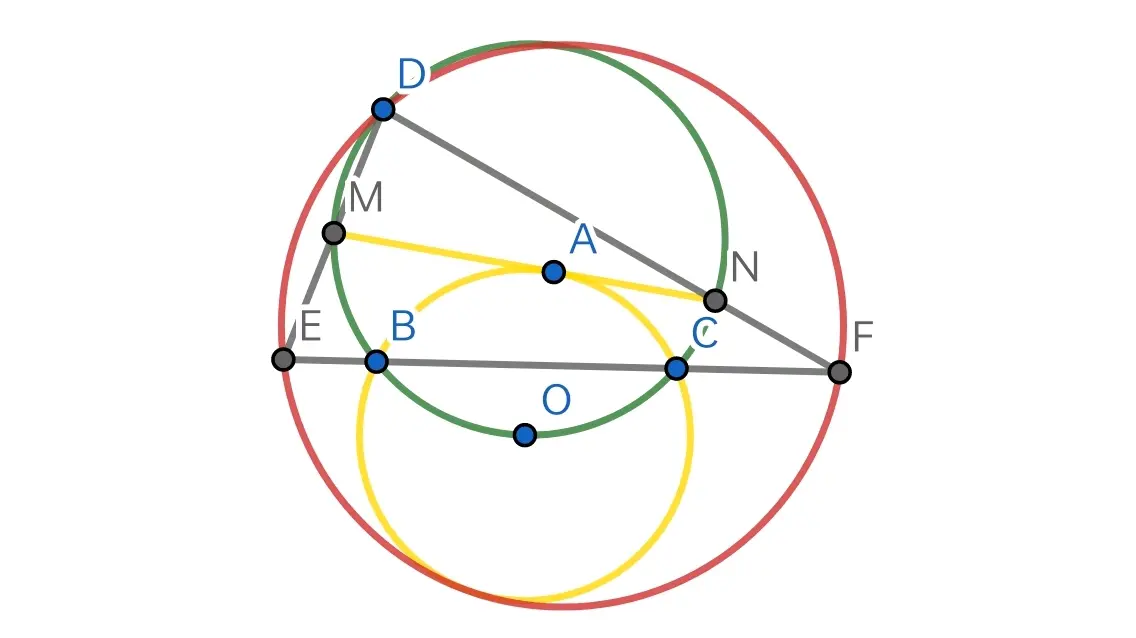
Problem 16: As shown in the figure: A, B and C are three points on ⊙O, D is a point on the circumcircle of △OBC, which is ⊙P. A line tangent to ⊙O at A intersects ⊙P at M and N. DM and DN intersect BC at E and F respectively. Let ⊙Q be the circumcircle of △DEF.
Prove: ⊙O is tangent to ⊙Q
》个人解——16/1.png)
The conditions are concise and the conclusion is elegant. However, the initial setup doesn’t offer immediate properties for combination. After observing the original diagram, I couldn’t find an intuitive way to define the point of tangency.
For general problems involving tangent circles, we usually follow these steps: Define a potential tangency point on one circle, prove it lies on the other, and then verify the tangency.
Noticing the homothety between the basic configurations, I developed the following approach:
》个人解——16/2.png)
Let ⊙(DEF) and ⊙(DMN) intersect at S. Point T (shown in the figure) is not yet defined and is used for observation. Let DT intersect ⊙(DMN) again at G,. It can be observed that GS and AS are isogonal lines of ∠MAS. Once the diagram is completed, this observation is straightforward. The reason for connecting DT is to define the tangency point T by transforming point G. The next section explains this transformation.
》个人解——16/3.png)
Let SG be the isogonal line of SA with respect to ∠MSN
Define a spiral similarity transformation with the following three parameters:
- Center of Rotation: S
- Angle of rotation: ∠MSE
- Similarity Ratio: MS/ES
| Before | → | After |
|---|---|---|
| M | → | E |
| A | → | K |
| G | → | T |
Under this transformation: M→E,N→F. Let K←A,G→T,By the preservation of shape in similarity transformations, we know that EKF are collinear, and SETF are concyclic. Furthermore, △SKF∽△SAN∽(due to isogonal lines)∽△SMG, and similarly, △SET∽△SAN。 If you are familiar with the conditions for Iranian inversion, the path forward becomes clear. Iranian inversion is applicable when multiple pairs of directly similar triangles share a common vertex, note the distinction from a simple spiral similarity!
》个人解——16/4.png)
Define an Iranian Inversion with the following three parameters:
- Center of Inversion: S
- Inversion Power: SG*SK
- Reflection Axis: the angle bisector of ∠GSK
| Before | ↔ | After |
|---|---|---|
| M | ↔ | F |
| E | ↔ | N |
| G | ↔ | K |
| A | ↔ | T |
| EF | ↔ | ⊙(SMN) |
| ⊙(BAC) | ↔ | ⊙(CBT) |
| MN | ↔ | ⊙(SEF) |
| B | ↔ | C |
Under this transformation:
M↔F,E↔N,G↔K,A↔T,
EF↔⊙(SMN),⊙(BAC)↔⊙(CBT),MN↔⊙(SEF) => B↔C,
Since O is the midpoint of arc BC, SO is the reflection axis for this transformation
By the Power of a Point theorem, ⊙(BAC) = ⊙(BTC),meaning T lies on ⊙(BAC). Due to the angle-preserving (conformal) property of inversion, since MN is tangent to ⊙(ABC), we know that ⊙(AMN) is tangent to ⊙(BCT). Q.E.D.
Summary
Regarding my method: Point G was introduced to construct the tangency point, and point K was a byproduct of the transformation. In practice, only G is essential; K could be removed from the formal write-up. I believe the logic is clear, though the isogonal lines is not easy to observe.
This is a truly elegant and difficult problem. Although my solution only introduces three points, the thought process is significant. There are also standard inversion methods, but they often result in more “cluttered” diagrams.
translated by me from my original post on bilibili
2026/2/23